


How to measure outbound beyond emails sent
Use a clear path from prospect coverage to commercial outcomes, with honest definitions and consistent reporting periods.
Sending activity shows that a campaign is running. Commercial performance shows whether the work is creating opportunities worth pursuing.
Both matter, but they answer different questions. A useful outbound report connects activity to the client’s sales process without treating every message, response or meeting as an equivalent result.
Define each stage
Start with a small set of measures that both parties can interpret consistently.
| Measure | What it tells you |
|---|---|
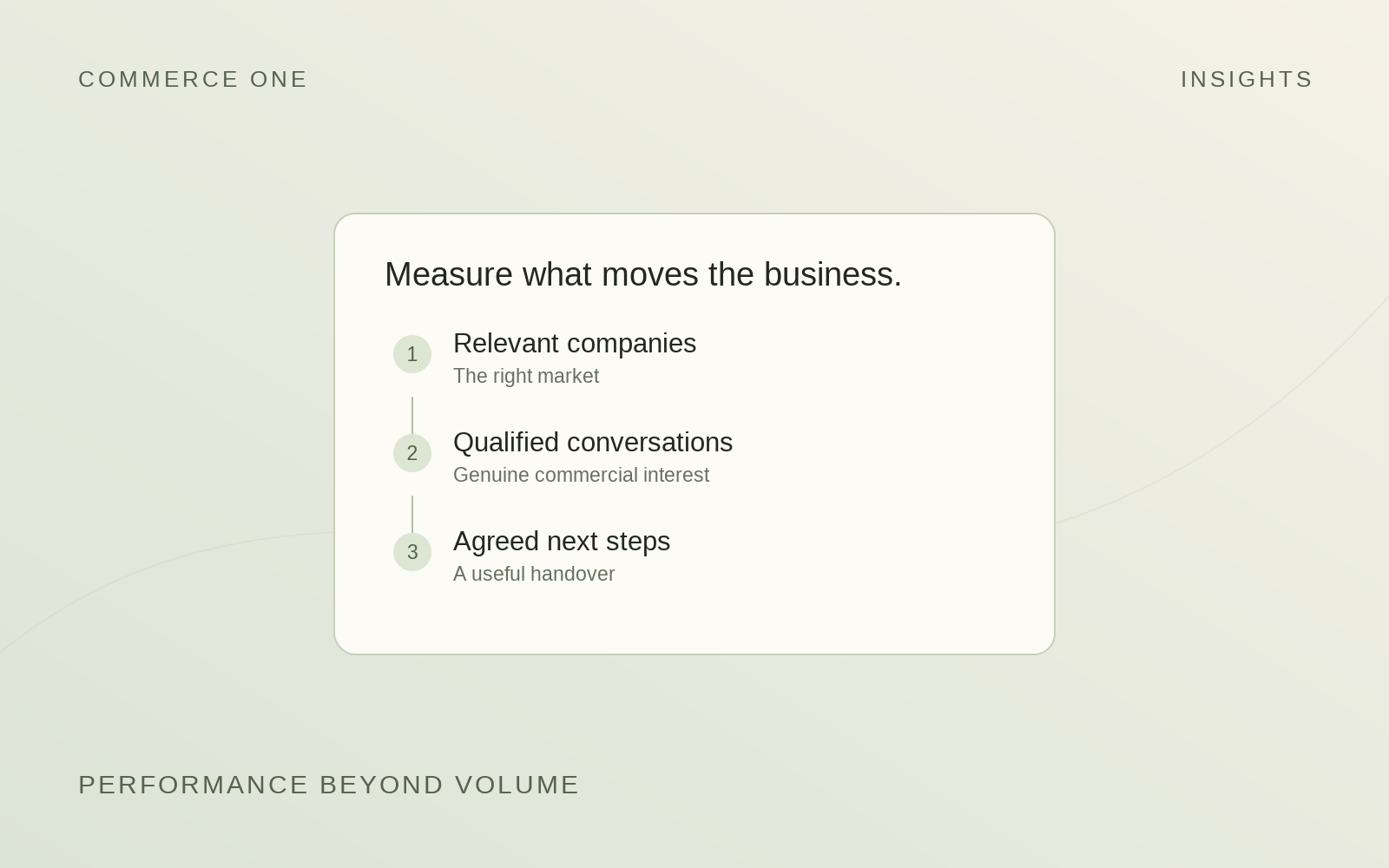
| New contacts approached | Unique people first contacted within the agreed audience |
| Messages sent | Activity, including follow-ups; separate from unique contacts |
| Human replies | Actual responses, classified by meaning |
| Qualified conversations | Conversations meeting the agreed fit, interest and next-step criteria |
| Accepted opportunities | Handovers the client’s sales team has accepted for progression |
| Won business | Sales confirmed by the client under the agreed attribution rules |
Suppression, bounces, complaints and opt-outs belong alongside these figures as operating measures. They help explain whether the campaign should continue, change or pause.
Record the reporting period and the population behind each rate. A conversation-to-opportunity rate needs a clear numerator and denominator. Combining this month’s newly contacted prospects with sales from a much older campaign can create a misleading picture.
Read the responses
Reply volume alone does not tell you whether the proposition is working.
A campaign may generate referrals because the initial contact role is wrong. It may generate interest from businesses that cannot meet the minimum order. It may expose a recurring technical question that needs a clearer answer.
The content of the responses helps identify what to change: audience, proposition, evidence, next step or handover process.
Open rates deserve particular caution. Apple explains that Mail Privacy Protection can download remote content in the background regardless of engagement. An open-tracking event therefore should not be treated as proof that a person read the message or intends to buy.
Connect costs to accepted outcomes
Cost per accepted opportunity can be useful when “accepted” has an agreed definition.
Consider an illustrative campaign with US$3,600 in attributable campaign costs and 12 accepted opportunities. The campaign cost per accepted opportunity is US$300.
If two of those opportunities later become confirmed customers, the campaign cost per acquired customer is US$1,800. If those sales produce US$7,000 in gross profit before campaign costs, US$3,400 remains after those costs, before other sales, overhead and financing costs.
This is a worked example, not a forecast or a Commerce One price quote. It also shows why sales revenue alone cannot describe profitability. Margins, fulfilment, internal sales effort and the time taken to collect payment all matter.
Allow the sales cycle to develop
A conversation created this month may produce a purchase much later. Review outcomes by cohort: the group of prospects approached during a defined period, followed through the sales process.
Existing opportunities, repeat customers and other acquisition channels also need agreed treatment. If a sale cannot be attributed reliably, report the uncertainty. Do not count the same sale several times because it appeared in multiple systems.
Use the report to decide what happens next
The useful decision is whether to continue, refine or expand.
Expand when the audience remains suitable, handovers are useful, the client can follow up and the economics support further work. Refine when response patterns point to a better segment or message. Pause when an issue needs resolution.
Commerce One’s Outbound reporting should be read alongside the client’s sales feedback. We can report the outreach and qualification work; the client needs to confirm later opportunity and sales outcomes for the commercial picture to be complete.
Discuss your outbound objectives or review the service scope.